The Focused AI Captain
How to Navigate the Storm, Empower Your Crew, and Deliver Real Value.THE NO-NONSENSE PLAYBOOK FOR AI TRANSFORMATION
Executive Summary
Enthusiasm is cheap. Transformation is expensive.
Despite billions in investment, only 5% of organizations have integrated AI at scale.
The gap isn’t technical. It is human.
Successful leaders know that AI isn’t a software update; it is a rewiring of value creation.
This playbook addresses the organizational design challenge—moving from “random acts of digital” to a systematic approach: Diagnose, Direction, Deliver.
The Capsize Ratio
Organizations spending 80% on tech and 20% on people sink. To survive, you must flip the ratio: 10% algorithms, 20% infrastructure, 70% people & process..
The Trust Gap
50% of frontline employees avoid sanctioned AI tools. Resistance is not malice; it is friction. Learn to convert fear into high-velocity adoption.
Establish Sea Lanes
Stop building gates. Build Sea Lanes—approved platforms with embedded governance that allow your crew to innovate at full speed without capsizing.
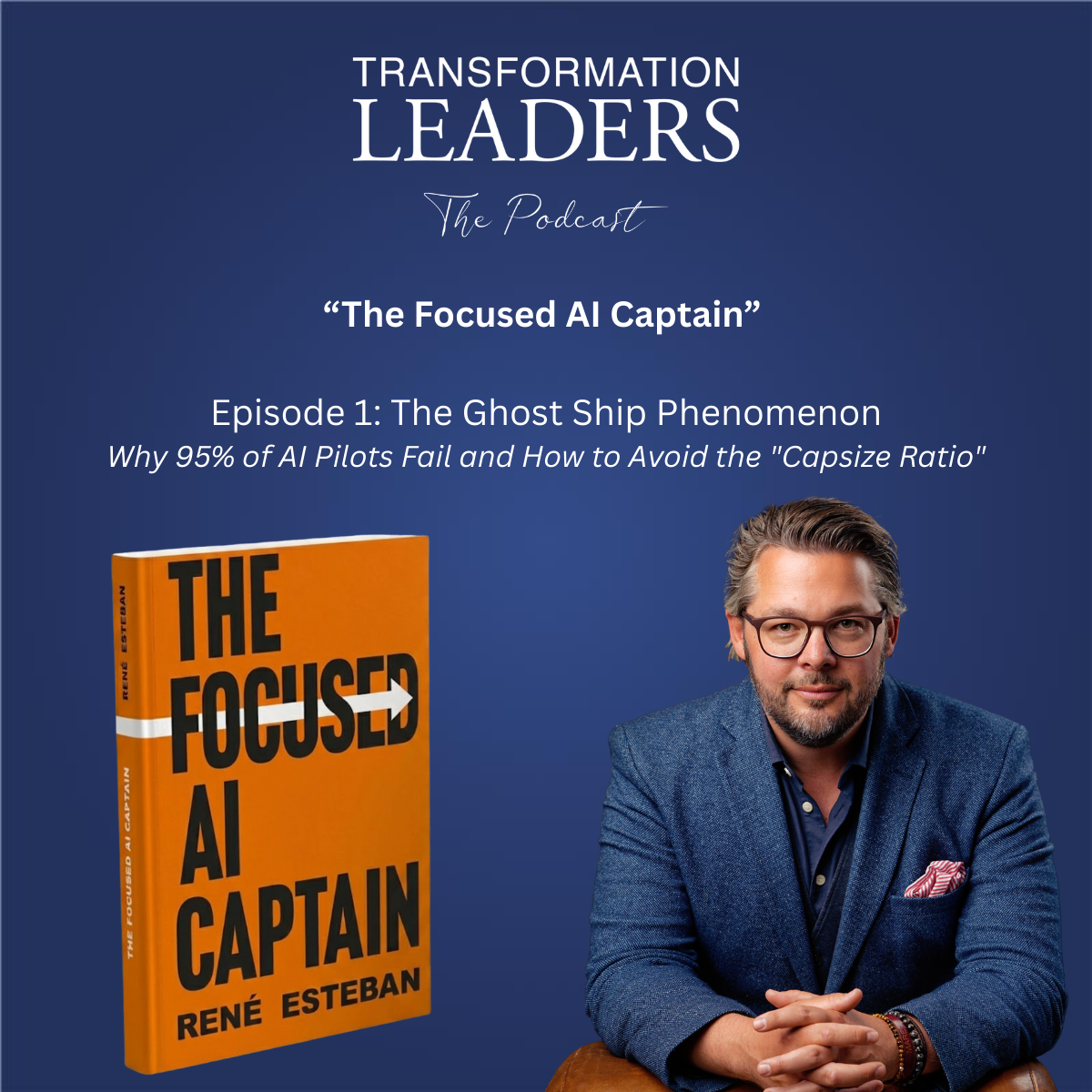
Listen to the special episode
In this special episode, René Esteban breaks down the “Ghost Ship” phenomenon. Listen to why the “10-20-70 Survival Rule” is non-negotiable for CFOs and how to establish the “Initial Bearing” for your organization before spending the next million on technology.
Listen on Spotify | Apple Podcasts | Deezer
From AI Adoption to AI Impact
Why Pilots die in Production.
The storm is here. The charts change every quarter. You can let the waves dictate your course, or you can take the wheel.
This section outlines the critical frameworks from the book that move you from diagnosis to delivery.
Start your diagnostic with our free tool: Take the AI Maturity Assessment →
The Strategy Trap
You cannot measure what you haven’t defined. 46% of mature AI companies lack structured ROI frameworks. Learn how to build a business case based on structural cost elimination, not fuzzy productivity gains.
The 3D Framework
Diagnose (Know where you actually are), Direction (Chart a course you can navigate), Deliver (Transform the organization). Most leaders skip straight to delivery and wonder why they fail.
The Governance Paradox
Traditional governance kills innovation. No governance kills the company. The solution is “Tiered Autonomy”—guardrails that enable speed for low-risk use cases while protecting the hull on high-stakes decisions.
Download: The Navigator's Toolkit
Access the digital resources mentioned in the book, including the AI Maturity Self-Check and the One-Page Strategy Template.
Download Tools & Templates
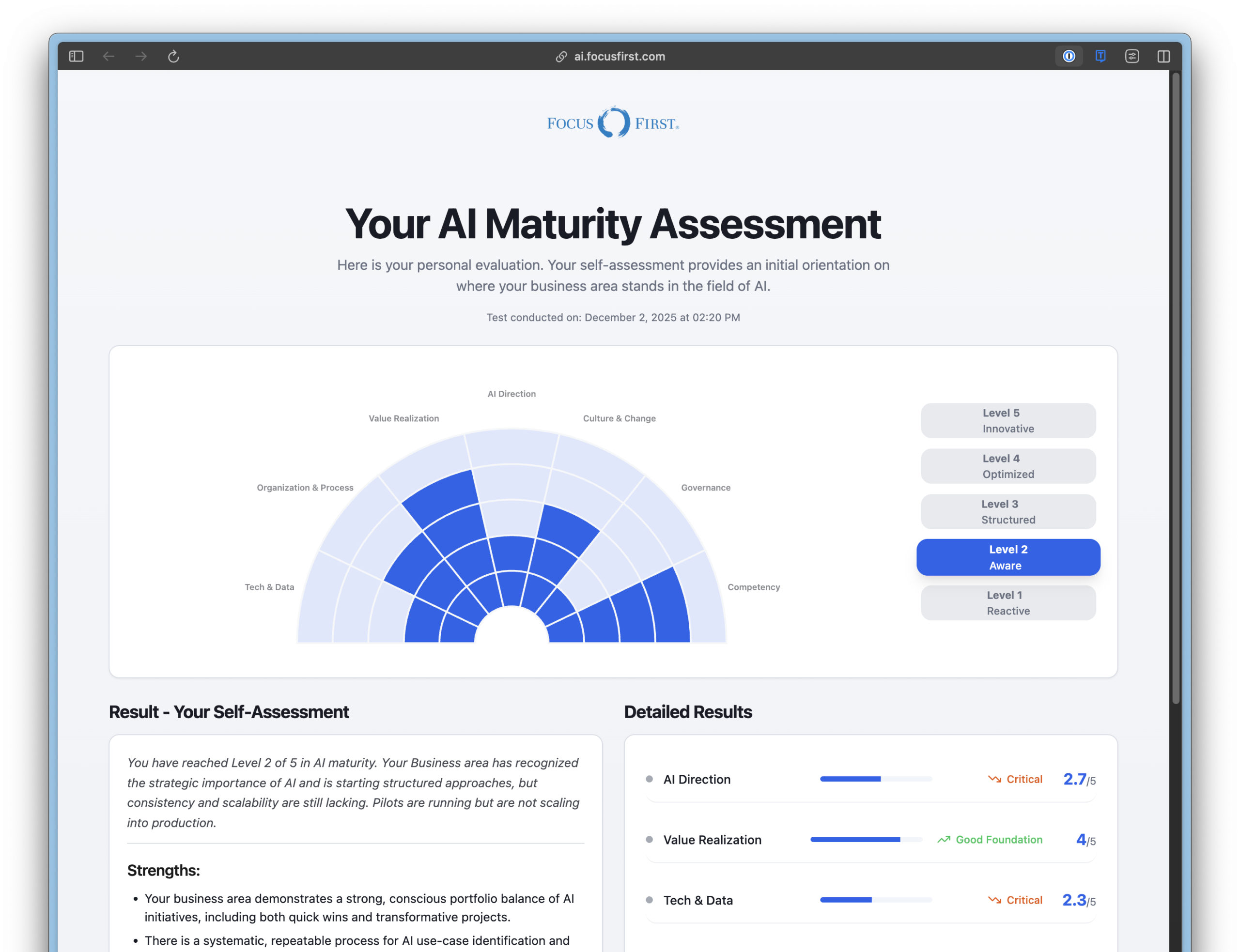
AI Maturity Quick Check
Find out in just a few minutes where
your organization stands with artificial intelligence.
Instant Results. No E-mail required.
Ready to Transform Your Organization?
Talk to Us
Schedule a complimentary consultation to discuss your “Capsize Ratio” and how to apply the 10-20-70 rule in your specific context.
Contact for Training
Inspire your leadership team. René Esteban delivers the hard truths about AI transformation—no fluff, just the mechanics of survival and success.
Book Summary
The Focused AI Captain
How to Navigate the Storm, Empower Your Crew, and Deliver Real Value
The Focused AI Captain offers a battle-tested framework for leaders navigating the turbulent waters of enterprise AI transformation. Drawing on nearly two decades of frontline experience across more than 250 transformation programs worldwide, the author provides a no-nonsense guide for executives who are tired of watching AI pilots fail and budgets evaporate without results.
The book opens with a stark reality: according to MIT and McKinsey research, 95% of enterprise AI pilots generate zero return on investment. The author argues that this staggering failure rate isn’t a technology problem. It’s an organizational design problem. While companies pour billions into algorithms and infrastructure, they fundamentally misunderstand what makes AI transformation succeed.
At the heart of the book lies The 10-20-70 Rule, a counter-intuitive resource allocation principle that separates successful transformations from expensive failures. The author reveals that organizations achieving real AI returns invest only 10% of their budget on algorithms, 20% on infrastructure, and a full 70% on people and processes. This human-centered approach flies in the face of conventional thinking, where technology typically consumes 80% of transformation budgets while adoption afterthoughts receive the remaining 20%.
The book introduces the 3D Impact Architecture, a systematic approach built around three phases: Diagnose, Direction, and Deliver.
In the Diagnose phase, the author walks readers through a comprehensive AI Maturity Assessment spanning seven critical dimensions: AI Direction, Value Realization, Tech & Data, Governance, Competency, Organization & Process, and Culture & Change. The book emphasizes that organizations cannot chart a course without knowing their starting coordinates, comparing this to using Google Maps without knowing your current location.
The Direction phase helps leaders craft a compelling OneGoal. This singular, inspiring vision mobilizes the entire organization. The author provides frameworks for building bulletproof business cases, developing realistic multi-year roadmaps, and orchestrating stakeholder alignment. A particularly valuable insight is the three-year reality check: Year 1 requires investment with negative or break-even returns, Year 2 sees scaling and emerging positive returns, and Year 3 delivers maturity and strong returns. Leaders who expect faster results, the author warns, join the 95% who never scale.
The Deliver phase tackles the execution challenges that kill most AI strategies. The book provides practical guidance on organizational design, advocating for a federated empowerment model that balances central governance with distributed innovation. The author addresses the critical but often overlooked human barriers to adoption, noting that nearly half of frontline employees with access to compliant AI tools actively avoid them. This resistance stems not from distrust of AI itself, but from distrust of how their organizations implemented it.
One of the book’s most actionable contributions is its approach to governance. Rather than bureaucratic approval processes that throttle innovation, the author advocates for platform-based governance with embedded guardrails. The book calls these “Sea Lanes”: designated routes where safety is built into the infrastructure itself, allowing teams to move at full speed within secure boundaries.
Throughout, the nautical metaphor of an AI Captain navigating stormy seas runs deep. The author reminds readers that captains aren’t born in calm waters. They’re forged in storms. The uncertainty of rapid AI evolution isn’t a threat to fear but a proving ground for bold, thoughtful leadership.
The Focused AI Captain is essential reading for C-suite executives, transformation leaders, and anyone responsible for making AI work in complex enterprise environments. It cuts through the hype to deliver practical frameworks, honest assessments of what actually works, and the strategic clarity needed to lead AI transformation rather than be swept away by it.
The storm is here. This book helps leaders take the wheel.
Frequently Asked Questions
How should I structure my organization for AI?
Adopt federated empowerment: a structure that enables autonomy within guardrails. Use a three-layer model: a Platform layer (15-20% of investment) providing central infrastructure, a Domains layer (60-70%) where functions own actual outcomes, and a Center of Excellence (10-15%) that enables and connects rather than controls. Start centralized, then evolve to distributed ownership as teams gain capability.
How long should I expect AI transformation to take?
Plan for a three-year journey. Year 1 is investment: training people, redesigning workflows, building foundations. Expect negative or break-even returns. Year 2 is scaling: deploying more broadly with emerging positive returns. Year 3 is maturity: full adoption with strong returns. Organizations that rush deployment without building Year 1 foundations join the 95% that never scale.
How should I allocate my AI transformation budget?
Follow the 10-20-70 Rule: invest 10% on algorithms, 20% on infrastructure, and 70% on people and processes. That 70% covers workflow redesign, change champions, training, and career pathway development. Organizations that flip this ratio, spending 80% on technology and 20% on capability building, consistently fail.
Why do 95% of AI pilots fail to generate returns?
The problem isn't technology. It's organizational design. Organizations treat AI transformation like a software deployment when it's actually an organizational redesign. They invest 80% in technology and only 20% in people, when the ratio should be reversed. The technology can be perfect, but if people don't trust it, don't understand it, or feel it's being imposed on them rather than created with them, it dies.
What framework does this book provide?
The 3D Impact Architecture: Diagnose, Direction, and Deliver. First, diagnose your actual AI maturity across seven dimensions. Then, set direction with a compelling OneGoal vision, strategy, business case, and roadmap. Finally, deliver through organizational design, talent strategy, change management, governance, and continuous measurement.
Why are employees resisting our AI tools?
Nearly half of frontline employees with access to compliant AI tools actively avoid using them, opting for unapproved solutions instead. This isn't resistance to AI. It's resistance to how you're implementing it. Workers use AI extensively at home. What they mistrust are the systems their employers mandate, tools imposed on them rather than co-created with them.
What is a OneGoal and why do I need one?
A OneGoal is a singular, inspiring vision that mobilizes your entire organization. Most AI transformations fail because the captain never made the destination clear. Different parts of the crew end up rowing in different directions. Your OneGoal should be concrete, ambitious, meaningful, and have a date on the calendar. A vision that only inspires the captain is worthless; you need one that mobilizes the entire crew.
What should I measure to know if AI transformation is working?
Track two interconnected dimensions: business value metrics (productivity gains, capacity expansion, cost elimination, risk reduction) and adoption indicators (daily active usage targeting 60%+, training completion at 90%+, shadow AI usage below 10%). Neither alone tells the complete story. High adoption without business value means AI isn't solving real problems. Business value with low adoption means you're not scaling.
How do I balance governance with innovation speed?
Implement platform-based governance with embedded guardrails, what the book calls "Sea Lanes." Instead of approving each deployment individually, build platforms where safety is structurally built-in. Use tiered autonomy based on actual risk: low-risk applications get immediate deployment rights, medium-risk requires lightweight review, and high-risk gets full governance oversight.
Do I need to hire armies of data scientists?
No. Building the right team isn't about hiring data scientists. It's about creating a balanced mix: AI Champions (business-side leaders who drive transformation from within), Technical Specialists (fewer than you think, roughly 1 per 3-5 Champions), Business Translators (the crucial bridge between technical possibilities and business needs), and Change Leaders (who build psychological safety and navigate stakeholder dynamics). Most successful organizations follow a 70-30 split: invest heavily in upskilling existing people while strategically bringing in outside talent.
Who can help us assess where we stand and make our organization AI-ready?
FocusFirst can help. With experience across more than 250 transformation programs worldwide, FocusFirst specializes in the comprehensive AI Maturity Assessment described in this book. Their approach combines deep expertise in organizational psychology and human behavior with technical knowledge of AI infrastructure and enterprise systems. They conduct structured stakeholder interviews, perform multi-dimensional mapping across all seven AI maturity dimensions, and deliver actionable recommendations that feed directly into your AI vision, roadmap, governance model, and change strategy. Whether you need to diagnose your starting point, define your direction, or execute delivery, FocusFirst provides the rare combination of skills required to make your organization truly AI-future proof.
Get the book
The storm is here.
This book helps leaders take the wheel.
Frankfurt
Neue Mainzer Straße 66-68
6th Floor, Eurotheum
60311 Frankfurt
Germany
Fon +49 69 870 078 740
hello@focusfirst.com
London
Golden Cross House,
8 Duncannon Street, London,
Greater London, WC2N 4JF
United Kingdom
Fon +44 20 3928 8285
hello@focusfirst.co.uk

Transformation success by design... not by chance.